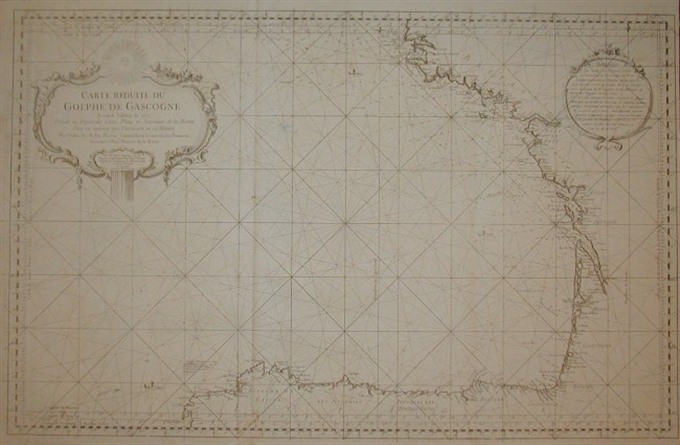
An antique nautical chart, taken from Jacques-Nicolas Bellin’s famous compendium *Hydrographie Françoise*, published in Paris in 1797, depicting one of the most crucial and treacherous maritime areas for European navigation between the 18th and 19th centuries: the Bay of Biscay (or Bay of Gascony).
The chart is distinguished by a pragmatic approach that prioritizes functional readability: ornamentation is skillfully limited to the title cartouche and technical notes, leaving the main body of the map uncluttered to allow navigators to easily consult the dense grid of loxodromic lines, which are essential for calculating courses on a constant compass bearing.
The area covered by the map extends along the Atlantic arc between the coasts of western France and the northern part of the Iberian Peninsula.
The French Coastline: The eastern part of the map meticulously documents the French Atlantic coast, starting from the southern part of Brittany (visible in the upper corner) and extending southward along the department of Vendée, through the Gironde region, to the coasts of the Landes and the Basque Country. The depiction follows the curved line of the gulf, highlighting the geological features and inlets that required special attention to prevent silting.
The Cantabrian Coast: The lower part of the map focuses on the northern coast of Spain, which faces the Gulf. It depicts the area stretching from the border with the French Basque Country to Galicia (identified as the “Royaume de Galice”). This area, characterized by high and rugged coastlines, historically served as an essential waypoint for routes that, from the heart of Europe, headed toward the South Atlantic, the Americas, or the Mediterranean via the Strait of Gibraltar.
The Watershed: In addition to the coastline, the map highlights the vastness of the Gulf, a body of water known for its significant depth in the open sea and its extreme turbulence. The rhumb lines crossing the body of water indicate the preferred routes that captains were to follow to minimize the risks associated with strong Atlantic currents and prevailing winds, which can change abruptly in this area.
The Hydrographie Françoise is considered the masterpiece of 18th-century maritime cartography. It was not an atlas intended merely as a reference volume, but an official “recueil” (collection), constantly updated with the latest discoveries. Designed to serve the King’s ships, it contained the most advanced charts of the era for every known sea in the world. Its strategic importance was such that copies of this work were often seized as spoils of war between the British and French navies, as they were considered vital tools for naval supremacy.
Jacques-Nicolas Bellin (1703–1772) A pivotal figure in French cartography, Bellin was the first Ingénieur de la Marine at the Dépôt des Cartes et Plans de la Marine, the official hydrographic office created to centralize the Kingdom of France’s nautical knowledge. Having entered the Navy at a very young age, he devoted over fifty years to revolutionizing the accuracy of nautical charts, making France a model of scientific excellence in Europe. His commitment extended beyond the production of maps to include the standardization of surveying techniques, profoundly influencing subsequent cartographic production.