


Copper engraving from “Atlante Novissimo, illustrato ed accresciuto sulle osservazioni, e scoperte fatte dai piu’ celebri e piu’ recenti cartografi” by Antonio Zatta published in Venice in 1779.Very good condition with nice and decorative original colours.
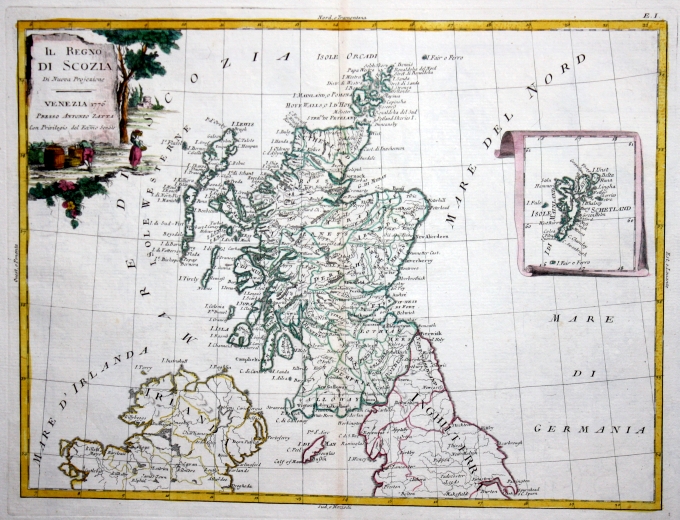
Il Regno Di Scozia Di Nuova Projezione.
Copper engraving from “Atlante Novissimo, illustrato ed accresciuto sulle osservazioni, e scoperte fatte dai piu’ celebri e piu’ recenti cartografi” by Antonio Zatta published in Venice in 1779.Very good condition with nice and decorative original colours.
- Year: 1779
- Dimension: 310 x 400mm
- Place of publication: Venice
€ 300,00
Related products
-
![]()
Lovely engraved map based on the cartography by C. Franz Radefeld (1788-1874) showing the whole Scotland inset little maps of Orkney and Shetland. From the “Meyer’s Neuester Zeitungs Atlas” published by Bibliographischen Instituts in Hildburghausen in 1849-52. The innovation of this work is that almost all maps had small inserts showing richly detailed maps of major cities and their surrunding areas: so not only could travellers carry the atlas with them easily, they could also obtain an initial
- Year: 1849
- Dimension: 205 x 235 mm
- Place of publication: Hildburghausen
-
![]()
Charming map of the region centered on Cambridge from the Mercator Hondius “Atlas Minor” published in Amsterdam in 1648 at Jannsonius with german text on verso. In 1607 Jodocus Hondius published a reduced size version of Mercator’s “Atlas”, itself suitably titled “Atlas Minor”. The maps were copied from those of the great cartographer Mercator of around 1580-90 or were reductions of Hondius’ own maps of 1606. Almost 20 years later Joannes Janssonius commissioned a new set of copperplates to be
- Year: 1648
- Dimension: 195 x 150 mm
- Place of publication: Amsterdam
-
![]()
One of only four maps of English counties by this Italian mapmaker. From ‘Atlante Novissimo’. Very good condition with nice and decorative original colours. [cod.1020/15]
- Year: 1779
- Dimension: 200 x 305 mm
- Place of publication: Venice
-
![]()
Copper engraving from “Atlante Novissimo, illustrato ed accresciuto sulle osservazioni, e scoperte fatte dai piu’ celebri e piu’ recenti cartografi” by Antonio Zatta published in Venice in 1779.Very good condition with nice and decorative original colours.
- Year: 1779
- Dimension: 320 x 410 mm
- Place of publication: Venice


