


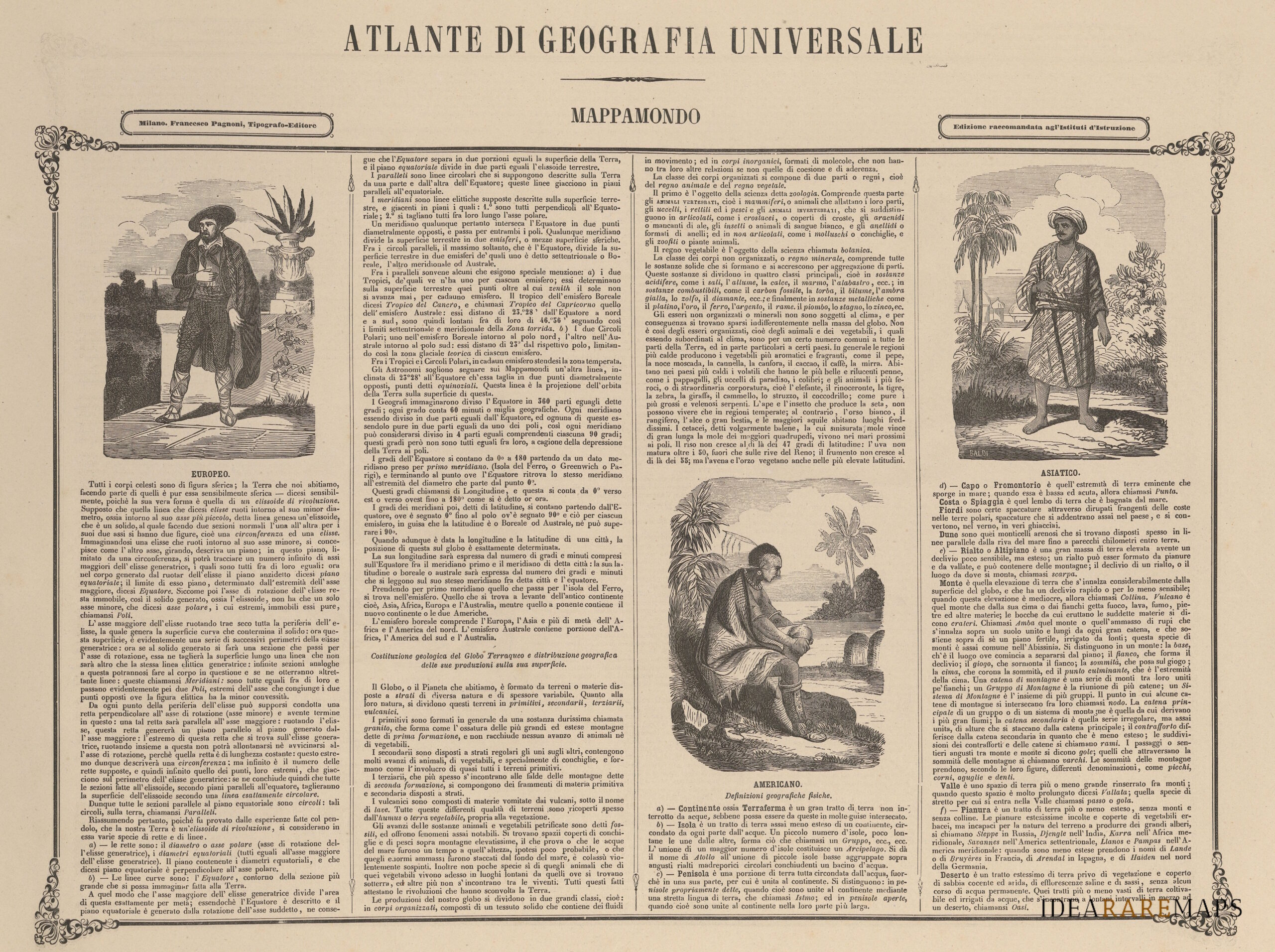
Uncommon elegant Italian map by Filippo Naymiller showing the world in two hemispheres published in Milan. Includes a second sheet of text embellished by vignettes engraved by Baldi. It provides really interesting geographical and statistical information of the continents. The map was finely engraved by Pietro Allodi. From Atlante di geografia universale: cronologico, storico, statistico e letterario. Milan, 1860 at Tipografia Pagnoni.


Mappamondo preso sul Meridiano di Parigi
Uncommon elegant Italian map by Filippo Naymiller showing the world in two hemispheres published in Milan. Includes a second sheet of text embellished by vignettes engraved by Baldi. It provides really interesting geographical and statistical information of the continents. The map was finely engraved by Pietro Allodi. From Atlante di geografia universale: cronologico, storico, statistico e letterario. Milan, 1860 at Tipografia Pagnoni.
- Dimension: 46 x 33 cm
- Place of publication: Milan
- Year: 1860
€ 280,00
Related products
-
![]() Out of stock
Out of stockA very attractive chart of the heavens and the zodiacal constellations designed by Lucien Boucher for Air France published at Atelier Perceval, 1951. The amazing promotional poster, decorated with many attractive drawings and designs, shows the constellations of the northern and southern skies overlain by a globe showing Air France routes. In the four corners cherubs blowing into the skies and the Milky Way flowing through the constellations.The map is decorated with many particulars shaded in gold.
- Dimension: 35 x 58 cm
- Place of publication: Paris
- Year: 1951
-
![]()
A large very decorative Japanese world map published as sugoroku (a Japanese game which might be compared to backgammon) published as a supplement to the 1930 New Year’s Day edition of the Osaka Mainichi Shimbun newspaper. The really interesting map is drawn on a Mollweide projection instead the more commonly used Mercator projection: cartographers use the Mollweide projection when an accurate representation of area takes precedence over the accuracy of shapes. Countries are in shades…
- Dimension: 1070 x 770 mm
- Place of publication: Osaka
- Year: 1930
-
![]() Out of stock
Out of stockDiese Weltkarte zeigt die Arbeit des Menschen und die Schätze und Wirtschaftsgüter der Erde
More InfoGrande e dettagliatissima carta pittoresca del mondo disegnata da F. Heinrichsen che mostra attraverso deliziose vignette l’ingegno e l’operosità dell’uomo e le caratteristiche di tutte le aeree della Terra: accanto a ogni toponimo sono infatti riportate le caratteristiche del luogo come per esempio il tabacco a Cuba, il rum e lo zucchero nelle isole caraibiche, oro e diamanti in alcune aree dell’Africa, petrolio in Arabia, le famose olive di Creta o le vignette degli agrumi…
- Dimension: 114 x 66,5 cm
- Place of publication: Stuttgart
- Year: 1947
-
![air france boucher]()
A very decorative world map by Lucien Boucher created for Air France published in Paris at atelier Perceval, 1939. This is one of the first maps of Air France which was founded in October 1933. Shows the beginning routes of the airline, extending west to the Americas and east to China. The route Paris-New York shown dotten because still in study (the first travel was in 1946). The whole world is filled with beautiful illustrations,…
- Dimension: 60 x 96 cm
- Place of publication: Paris
- Year: 1939


