


Nautical chart from J. Roux’s “Carte de la Mer Mediterranee en douze feuilles? published in Marsile in 1764. Sanderson, The Sea Chart, p. 91. Rare. [cod.1193/15]
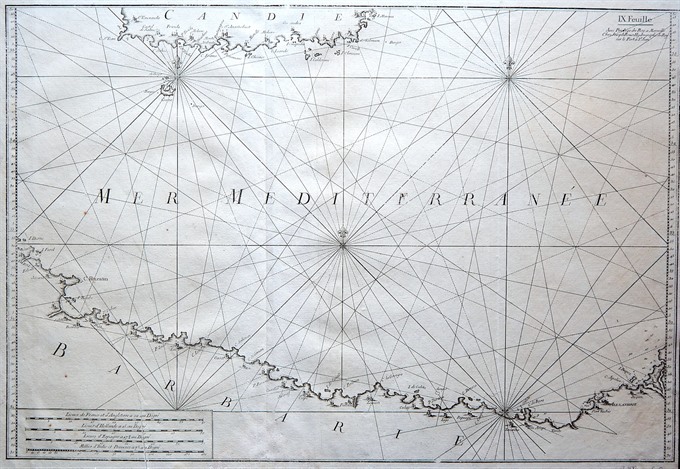
Candia. IX Feuille
Nautical chart from J. Roux’s “Carte de la Mer Mediterranee en douze feuilles? published in Marsile in 1764. Sanderson, The Sea Chart, p. 91. Rare. [cod.1193/15]
- Year: 1764
- Dimension: 800 x 545 mm
- Place of publication: Marsiglia
€ 600,00
Related products
-
![]()
Detailed map of Crete published in 1866 by Dietrich Reimer and based on the representation of the island drawn by the English hydrographer, geologist and vice-admiral Thomas Abel Brimage Spratt (1881-1888). The interesting map also features an inset with the valley of Mylopotamos, a locality in the northern part of the island, in the prefecture of Rethymnon. It will be reprinted in 1897 (Cf. Bibliothèque nationale de France, GED-2736 ) with the addition in plate…
- Dimension: 25 x 54 cm
- Place of publication: Berlin
- Year: 1866
-
![]()
Nice map of northern Greece with the southern parts of present day Macedonia and Albania. Includes Athens. Strapwork title cartouche in the lower left corner. From the Mercator Hondius “Atlas Minor” published in Amsterdam in 1648 at Jannsonius with german text on verso. In 1607 Jodocus Hondius published a reduced size version of Mercator’s “Atlas”, itself suitably titled “Atlas Minor”. The maps were copied from those of the great cartographer Mercator of around 1580-90 or were reductions of Hon
- Year: 1648
- Dimension: 205 x 145 mm
- Place of publication: Amsterdam
-
![]()
Very decorative and rare plan of the city of Candia on the island of Crete. From Coronelli’s Corso Geografico Universale published in Venice in 1690. Vincenzo Maria Coronelli is widely recognised as one of Italy?s most famous and greatest cartographers. He received an ecclesiastical education at the convent of the Minor Conventuals and also studied theology in Rome. However, his interests in geography and cartography were awoken early in his ecclesiastical career and never suppressed. He made ve
- Year: 1690
- Dimension: 450 x 600 mm
- Place of publication: Venice
-
![]() Out of stock
Out of stockVery decorative prospect view of Athens showing the major buildings and places of interest. From Corso Geografico Universale by Coronelli published in Venice in 1690. Vincenzo Maria Coronelli is widely recognised as one of Italy’s most famous and greatest cartographers. He received an ecclesiastical education at the convent of the Minor Conventuals and also studied theology in Rome. However, his interests in geography and cartography were awoken early in his ecclesiastical career and never suppressed.…
- Year: 1690
- Dimension: 610 x 458 mm
- Place of publication: Venice


